
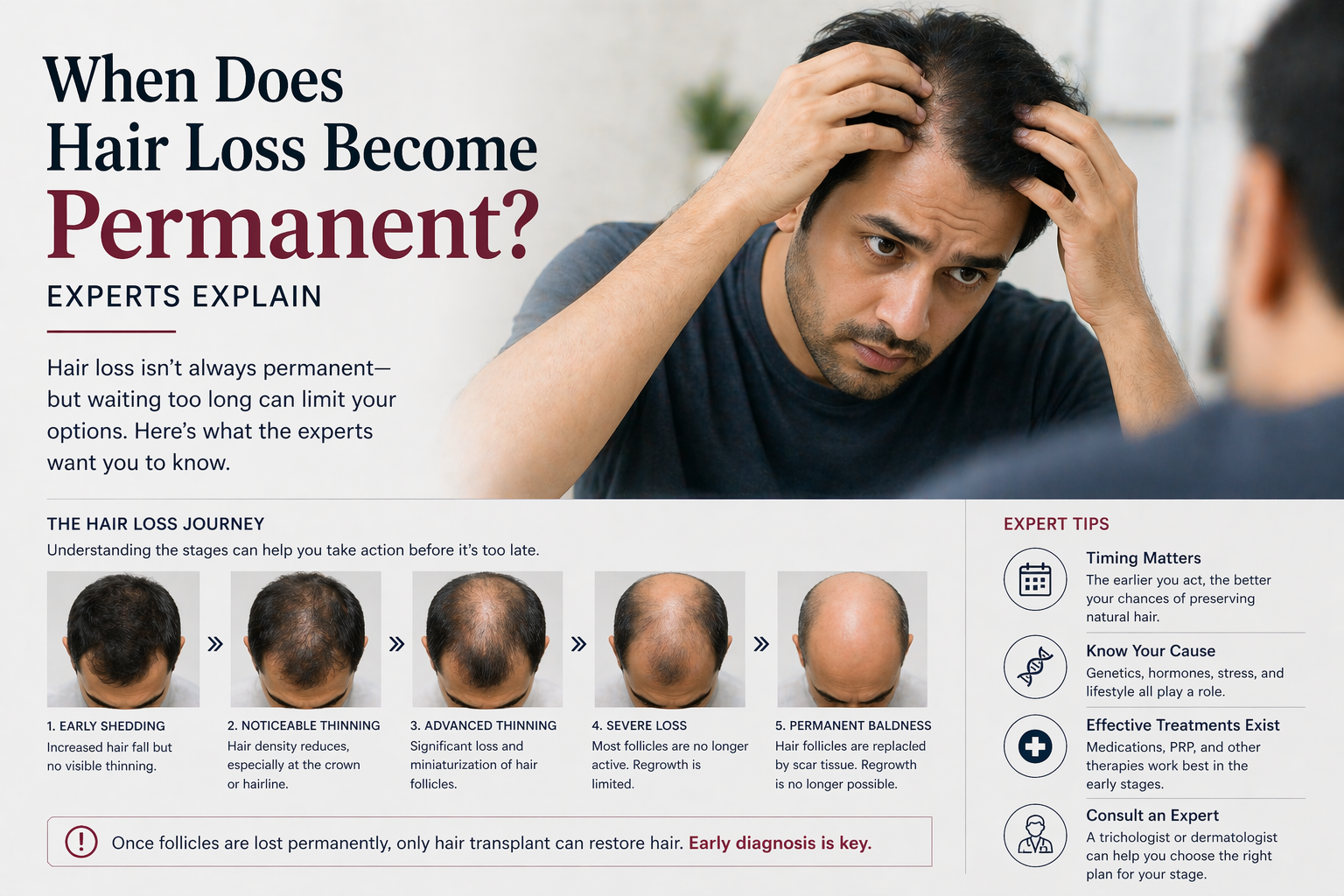
Almost everyone loses hair. Fewer people know the difference between hair that will come back and hair that won’t. Understanding that line, clinically, biologically, and honestly, is one of the most useful things a patient can do before spending money on any treatment.
The Hair Cycle in Plain Terms
Every follicle on your scalp moves through three phases:
- Anagen: the growth phase, which lasts two to seven years.
- Catagen: a short transitional phase of two to three weeks.
- Telogen: the resting phase, after which the hair sheds and the follicle starts the cycle again.
At any given time, about eighty-five percent of your scalp hair is in anagen, ten percent in telogen, and a small fraction in catagen. Losing around a hundred hairs a day is entirely normal. That’s just telogen doing its job.
Hair loss becomes a medical concern when the cycle itself starts to break down: either the growth phase gets shorter, the resting phase gets longer, or the follicles themselves begin to shrink.
The Crucial Concept: Follicular Miniaturisation
Permanent hair loss is usually preceded by miniaturisation. A follicle doesn’t go from producing healthy hair to producing nothing overnight. Over years, it produces progressively thinner, shorter, lighter hairs with each cycle. Clinicians can see this under a scope long before it becomes obvious in the mirror.
During the miniaturisation window, the follicle is still alive. Medical and regenerative treatments can meaningfully slow the process, and in many cases, partially reverse it. The hair becomes denser, stronger, and more pigmented.
Eventually, though, the follicle loses its ability to respond. It stops producing any shaft at all. The follicular unit either disappears or becomes fibrotic. From that point on, that specific follicle is permanently lost. No medication, no injectable, no supplement will bring it back.
Signs Your Hair Loss Is Still Reversible
A dermatologist examining your scalp will typically look for:
- Variation in hair shaft diameter, a sign of ongoing miniaturisation rather than completed loss.
- Preserved follicular density under trichoscopy, even if visible volume looks reduced.
- Active anagen activity in the affected zones.
- Short history (less than three to five years) of the thinning.
- Absence of scarring on the scalp surface.
If most of these are present, you’re still inside the window where medical therapy, regenerative options, and lifestyle correction can change the trajectory.
Signs the Loss Is Already Permanent
By contrast, features that point towards completed, permanent loss include:
- Shiny, smooth scalp surface in the affected zones, indicating the follicular openings are gone.
- Absent or near-absent follicular density on trichoscopy.
- A long history of bald patches unchanged for several years.
- Scarring alopecia, where inflammation has destroyed the follicle permanently.
In these cases, medications can protect surrounding hair and regenerative therapies can support remaining follicles, but they cannot repopulate the lost zones. The only credible option for restoring density in permanently lost areas is surgical transplantation, moving follicles from the donor zone at the back and sides of the scalp into the affected area.
Where Surgical Restoration Fits
Modern FUE Hair Transplant techniques work precisely because the follicles at the back and sides of the scalp are genetically resistant to the hormonal signals that cause pattern hair loss. When transplanted into areas where native follicles have been lost, these donor follicles retain their resistance and continue to produce hair in their new location.
That said, timing still matters. Clinicians at Kibo Clinics emphasise that performing a transplant too early, before the pattern of loss has stabilised, can create unnatural results as surrounding native hair continues to thin around the transplanted zone. A well-planned restoration accounts not just for what the scalp looks like today, but what it will look like in ten to fifteen years.
Expert Tip
Don’t rely on the mirror alone. Ask a dermatologist to do a trichoscopic examination, a close-up scan of your scalp surface. The difference between miniaturising follicles and permanently lost follicles is often invisible to the naked eye, but unmistakable under magnification. That single exam can save you from chasing the wrong treatment for years.
The Honest Takeaway
Hair loss becomes permanent when the follicle loses its ability to respond, not simply when the hair becomes visibly thinner. The window between those two states, sometimes years long, sometimes much shorter, is the window in which non-surgical treatments still have real power. Once it closes, surgery becomes the only way to restore density. Knowing where you stand on that timeline is the single most important piece of information you can have before making any treatment decision.